Your CI/CD pipeline just deployed an AI agent. It has a service account, a long-lived API key, and access to your production database, your Slack workspace, and your GitHub org. Nobody filed a ticket. Nobody reviewed the scope. The agent is live, and your IAM system has no idea it exists.
That's not a hypothetical. A 2026 survey of 919 executives and practitioners found that 82% of executives feel confident their existing policies protect them from unauthorized agent actions - yet only 47.1% of an organization's AI agents are actually monitored or secured[1]. More than half of all deployed agents operate without any security oversight or logging. The confidence is a mirage.
This guide is for the platform and dev-tooling engineers who have to close that gap - without turning every agent deployment into a three-week approval process.
Why Agents Break Traditional IAM
Traditional IAM was designed around a simple model: a human logs in, gets a session, does some work, logs out. Every assumption in that model breaks with autonomous agents.
The session model collapses. AI agents operate continuously without sessions, making them difficult to monitor using identity signals like IP address, location, or device context[2]. There's no login event to anchor a policy decision to.
Credentials are inherited, not scoped. Agents determine their access needs dynamically at runtime, so pre-provisioned permission sets either over-grant access (expanding blast radius) or under-grant it - causing failures that teams resolve by granting even broader access[3]. The practical result: agents end up with the full permission set of the developer who provisioned them.
Sub-agents fracture accountability. When agents delegate tasks to sub-agents, accountability chains fracture - no system tracks which agent authorized which sub-agent to act or what permissions were passed along[4]. If a sub-agent inherits the full human credential, your attack surface expands across the entire chain.
Non-determinism makes scope unpredictable. An agent asked to summarize customer support tickets may infer that billing history would improve the summary. If the billing API is accessible under the agent's inherited credentials, the agent calls it - not maliciously, not because of a misconfiguration, but because the model inferred it was useful and nothing blocked the call[5].
The result is a new class of zombie identity. When over-provisioned agents outlive their projects, they often become zombie agents - orphaned identities with valid credentials, active permissions, and no human owner[6]. Your offboarding process was never designed to catch them.
The MCP Reality Check: A Protocol With No Auth Enforcement
The Model Context Protocol has become the de facto standard for connecting AI agents to tools and data. MCP crossed 97 million monthly SDK downloads (Python and TypeScript combined) and the Linux Foundation now governs the protocol through the Agentic AI Foundation, co-founded by Anthropic, OpenAI, and Block, with Google, Microsoft, AWS, and Cloudflare as platinum members[7].
The governance story is solid. The security posture of deployed servers is not.
A scan of 500+ production MCP endpoints found that 38% of servers have no authentication at the MCP protocol level - meaning any AI agent, or any HTTP client, can enumerate every available tool and in many cases execute them directly[8]. Among those unprotected servers are CI/CD pipeline triggers, database query interfaces, and cloud infrastructure controls.
Trend Micro's follow-up scan found the number of exposed MCP servers had nearly tripled to 1,467, with 1,227 of them still using the long-deprecated SSE transport[9]. The exposure problem has reached the cloud.
The spec has a clear answer to this. MCP's OAuth 2.1 profile mandates PKCE for all authorization code flows, removes the implicit grant and resource owner password credentials grant entirely, and requires tokens to be bound to a specific MCP server via resource indicators (RFC 8707)[10]. The problem is that "authorization is OPTIONAL for MCP implementations" - and most operators are taking that option.
Only 8.5% of MCP servers use OAuth — the rest rely on static API keys, basic credentials, or nothing at all (BlueRock Security analysis of ~7,000 public servers). Implementing OAuth 2.1 + PKCE is not a nice-to-have; it's the minimum viable security posture for any agent touching production systems.
Five Patterns That Actually Work
1. Short-Lived, Scoped Tokens - Not Long-Lived API Keys
The single highest-impact change platform teams can make is eliminating standing credentials for agents. For autonomous systems, least privilege should be treated as a runtime decision model, not a one-time access grant - the most effective pattern combines workload identity, intent-based authorization, and just-in-time credential issuance[11].
In practice: the agent first proves what it is through workload identity (SPIFFE SVID, Kubernetes OIDC, or cloud-native attestation), requests only the access needed for the current task, and loses that access as soon as the task completes. No standing privilege restored. No permanent expansion of the baseline role.
For MCP specifically, design OAuth scopes per tool - for example mcp:tool:read_file:read - so each token grants only the exact action it needs[10]. Resource indicators (RFC 8707) bind each token to one MCP server, blocking cross-server token replay.
2. Just-in-Time Access for Elevated Operations
JIT access is the bridge between zero standing privilege and developer productivity. When an agent legitimately needs a blocked permission, the request flows through an approval path - submitted via Slack or a developer portal, approved in seconds, granted for the duration of the task, and automatically revoked at completion.
Microsoft's defense-in-depth guidance for autonomous agents recommends scoping capabilities to the duration of a specific task, with task-focused permissions preferred because they naturally expire when the task completes[12]. Temporal permissions are the fallback when task-based limits aren't feasible.
The key design principle: the question is not "should we restrict this?" but "have we explicitly permitted this?" Default deny, explicit allow.
3. Policy-as-Code at the Tool Layer
Embedding authorization logic inside agent application code is a governance anti-pattern - it's invisible to security teams, untestable in isolation, and doesn't survive agent updates. The alternative is externalizing policy into a declarative layer that evaluates every agent-initiated action before execution.
A least-privilege AI agent gateway pattern using Open Policy Agent (OPA) validates every request, authorizes it using policy as code, and executes it in short-lived isolated environments with built-in observability via OpenTelemetry[13]. The gateway mediates every request and limits execution to the minimum required permissions.
Policy-as-code gives you three things ticket queues can't: version-controlled access rules, automated enforcement at machine speed, and a testable contract between what the agent is allowed to do and what it actually does.
4. A Trusted Agent Registry
82% of enterprises have discovered previously unknown AI agents in their environments in the past year, with 41% saying this happened multiple times - shadow agents most commonly emerge in internal automation or scripting environments and developer-created workflows[14].
You cannot govern what you cannot see. A trusted agent registry solves the discovery problem by making registration a prerequisite for deployment - not an afterthought. Every agent gets a unique, verifiable identity. Every MCP server gets an entry in the registry with its approved tool set, its owning team, and its access policy. Agents not in the registry don't get tokens.
This is the same pattern that works for human identities: you don't grant access to users who aren't in the directory. Apply the same logic to machines.
5. Least Privilege Per Tool/Scope, Not Per Agent
The granularity matters. Granting an agent "read access to GitHub" is not least privilege - it's a broad standing credential with a narrow label. Access control must happen at the point of tool invocation, where the agent's request passes or fails against its defined scope[5].
Concretely: a code-review agent should be able to call list_pull_requests and read_file on specific repositories. It should not be able to call delete_branch, push_commit, or read_secrets. Those are different tools, and each needs its own explicit authorization decision.
Gartner identifies approximately 40 tool definitions as the threshold beyond which agent latency and token cost increase measurably - every tool definition loaded into an agent's context consumes tokens whether the tool is ever called or not[5]. Least privilege isn't just a security control; it's also an operational efficiency and cost control.
Self-Service Within Guardrails: The Developer Experience Problem
The reason developers bypass governance isn't malice - it's friction. A ticket queue that takes three days to approve a new MCP server connection is a ticket queue that gets circumvented. The goal is to make the governed path the path of least resistance.
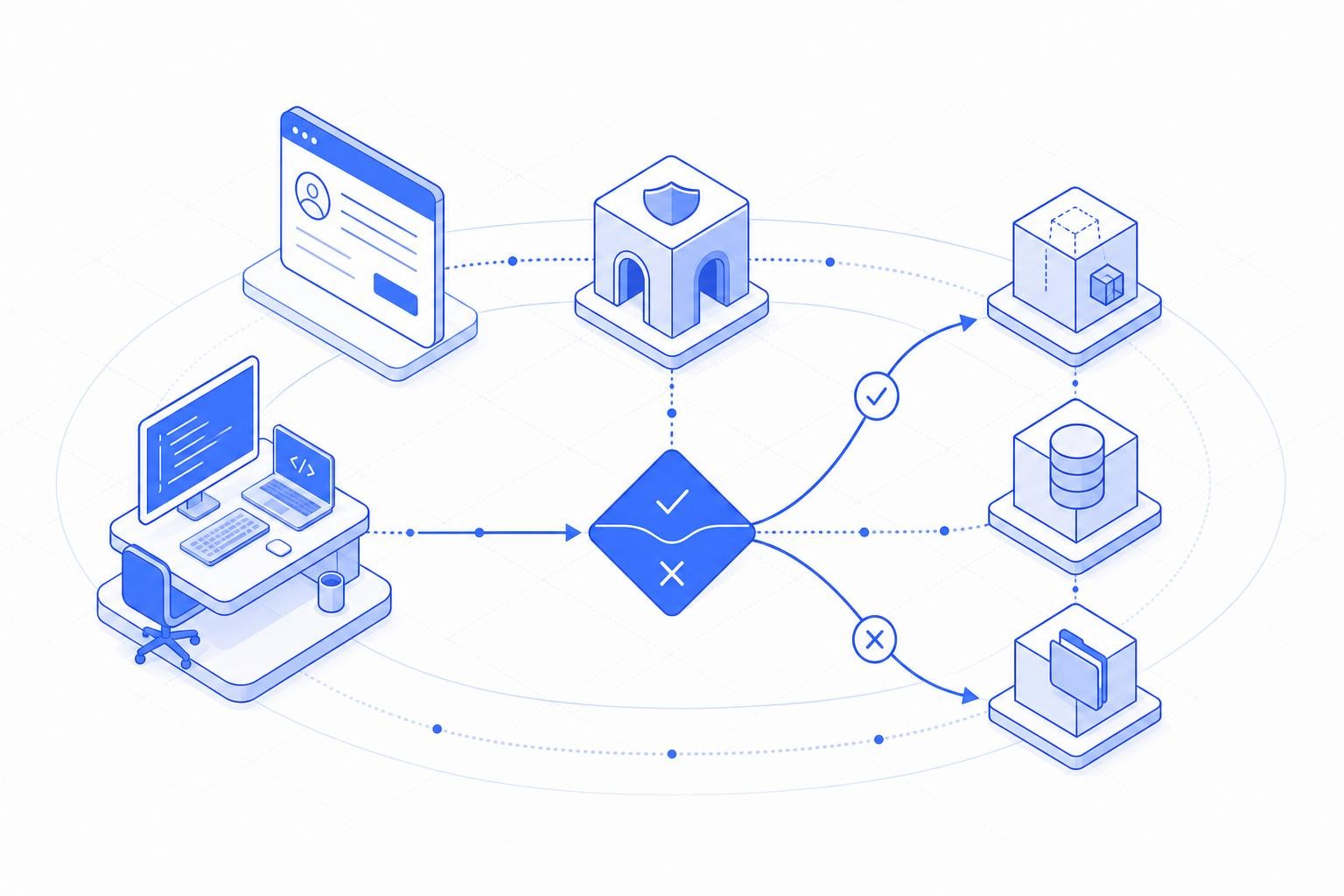
The architecture that works looks like this:
- A self-service catalog of pre-approved agent personas and tool bundles. A developer deploying a code-review agent picks from a governed menu, not a blank permission form.
- Automated policy evaluation that approves low-risk requests instantly and routes elevated requests to a human approver with full context.
- Infrastructure-as-code integration so agents can be registered via Terraform or Helm, with access policies declared alongside the deployment manifest.
- Automated lifecycle management that ties agent credentials to the deployment lifecycle - when the agent is undeployed, the tokens expire automatically.
The Agent Control Plane pattern lets developers register agents via Terraform and exchange existing tokens such as Kubernetes OIDC for specifically scoped temporary tokens that expire automatically when the agent is undeployed - improving security without creating a new bottleneck in the development workflow[15].
The governance burden shifts from "approve every request manually" to "define the policy once, enforce it automatically." That's a model lean platform teams can actually sustain.
This is exactly the gap Iden is built to close - unified governance of human and non-human identities, with fine-grained control down to the tool and scope level, without the ticket-queue bottleneck. For a deeper look at the access patterns, see our Step-by-Step Guide to Securing AI Agent Access and How to Build an Agentic Identity Governance framework.
The Governance Confidence Gap: A Decision Tool
Before you build your implementation plan, it helps to know where your current posture actually sits. Use this tool to assess your agent governance maturity and get a prioritized action list.
Implementation Checklist for Platform Teams
This is the concrete sequence. Work through it in order - each layer depends on the one before it.
Run a discovery sweep across your cloud accounts, CI/CD pipelines, developer workstations, and SaaS platforms. Catalog every agent identity, its owning team, its credential type, and every MCP server it connects to. If you can't enumerate them, you can't govern them.
Every agent needs an accountable human owner — not a team alias, a named individual. This is the prerequisite for access reviews, incident response, and lifecycle management. Agents without owners are zombie identities waiting to happen.
Require the authorization code flow with PKCE (S256 method) on every internet-accessible MCP server. Remove implicit grants. Implement resource indicators (RFC 8707) to bind tokens to specific servers. This is the MCP spec's security baseline — treat it as mandatory, not optional.
Audit every agent credential. Replace static API keys with workload identity attestation (SPIFFE SVIDs, Kubernetes OIDC, or cloud-native equivalents) that issue short-lived tokens per task. Set maximum token TTLs of 15–60 minutes for most agent operations.
Define the exact tool set each agent persona is authorized to call. Externalize this policy into OPA or a comparable policy engine. Enforce at the gateway layer — not inside agent application code. Every tool invocation should pass or fail against a declared policy.
Create a governed menu of pre-approved agent personas and tool bundles. Route low-risk requests to instant automated approval. Route elevated requests to a human approver with full context. Integrate registration into your IaC workflow so agents are governed from their first deployment.
Log every tool invocation with: agent identity, human owner, tool called, parameters (sanitized), timestamp, and policy decision. Store logs in an immutable, queryable system. This is your forensic trail when something goes wrong — and the evidence your auditors will ask for.
Tie agent credential validity to the deployment lifecycle. When an agent is deprovisioned, its tokens should expire automatically. Run quarterly access reviews on all agent identities the same way you review human access. Quarantine deprecated agent roles rather than leaving them active with standing permissions.
The Governance Gap Is Structural, Not Cosmetic
Only 18% of security leaders are highly confident their current IAM systems can effectively manage AI agent identities - the rest are somewhere between moderately confident and not at all[16]. That's not a tooling problem. It's an architectural one. IAM systems built for human sessions, password-based authentication, and human-speed access patterns were never designed for autonomous agents that operate continuously, spawn sub-agents, and make hundreds of API calls per minute.
The patterns in this guide - short-lived tokens, JIT access, policy-as-code, a trusted registry, per-tool least privilege - are not novel. They're the same principles that work for human identity governance, adapted for machine velocity. The difference is that agents require enforcement at runtime, at every tool invocation, with automated lifecycle management that doesn't depend on a human remembering to revoke access.
Platform teams that build this infrastructure now are buying compounding security advantage. Every agent deployed into a governed environment is one less zombie identity, one less standing credential, one less unmonitored execution path into your production systems.
The ticket queue isn't the answer. Governed self-service is.